
The fastMOT Young Researchers Exchange recently brought early-career scientists together at University College London (UCL) for two intensive and inspiring weeks of collaboration, innovation and cultural exchange. Hosted at UCL, PhD students from across the consortium worked side by side to advance simulations in time-domain optical techniques, strengthen cross-institutional partnerships, and accelerate progress within the fastMOT project.
Tommaso Palo
PhD Student at Politecnico di Milano:

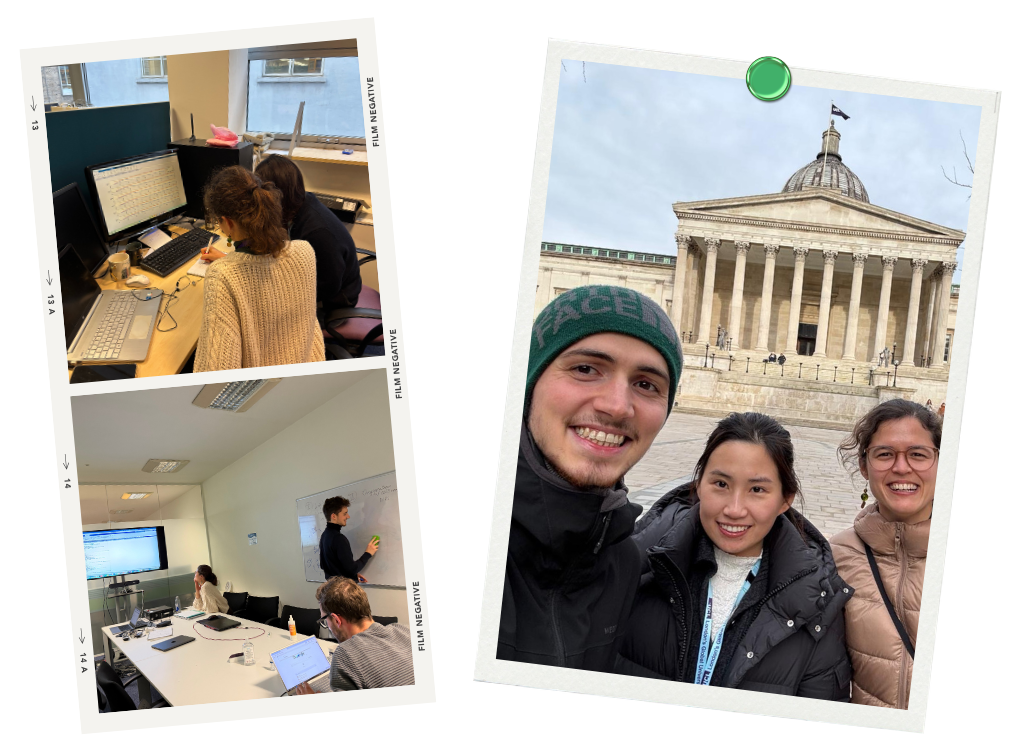
I’ve spent three wonderful weeks in London, working with my fastMOT colleagues on TD-NIRS and TD-DCS simulations. Xingmin and Fred hosted Lisa and me in their UCL office, taking time to teach us how to run simulations using their software and helping us set up connections to their powerful computers.
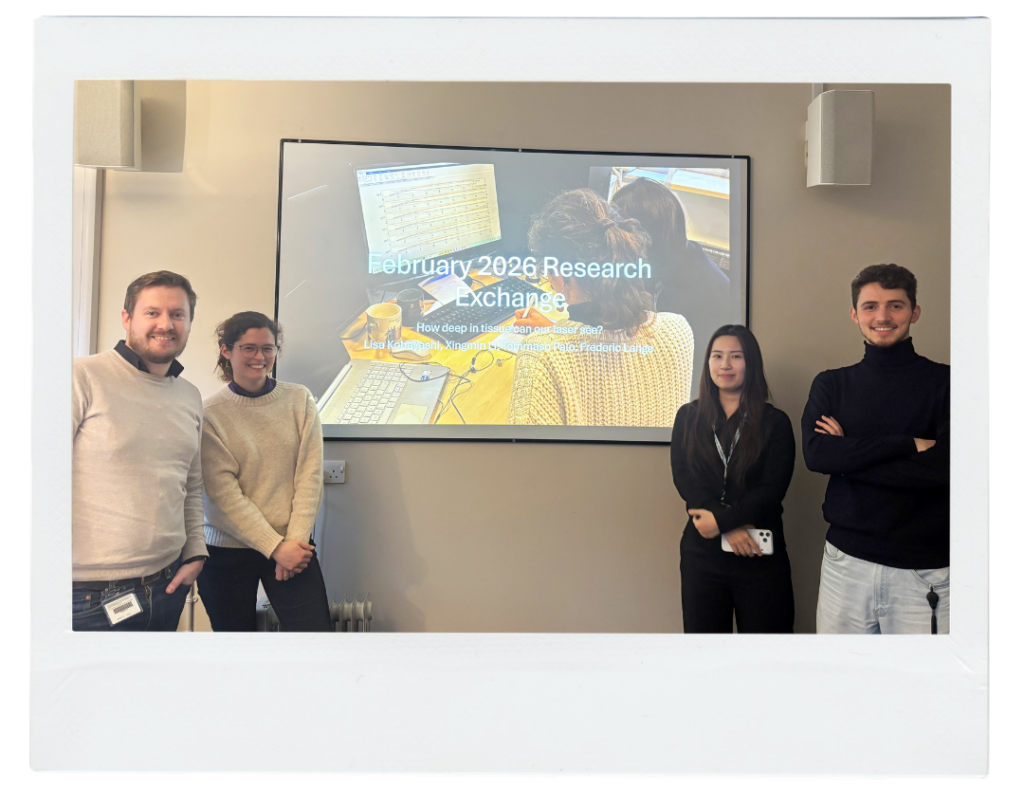
Our main objective was to evaluate how our laser-detector system can observe biological changes at various depths. Xingmin generated time-of-flight curves for me to analyse using TD-NIRS, while Lisa focused on the TD-DCS analysis. Working towards our deadline, we prepared a presentation to show our progress to the consortium. When the day arrived, we were tired but satisfied with our work. It was rewarding to explain our findings to the professors and engineers collaborating on the project.
While it was a work exchange, we also took time to enjoy London together. Xingmin took us to try various restaurants, mostly Asian cuisine, which I think I will miss a lot. We also had a fancy dinner in an Italian restaurant that served great pizza.
On the weekends I also took the chance to see the great museums of London as well as the Camden neighborhood, a truly special place full of interesting shops that you can’t find anywhere else.
Xingmin Li
MRes+PhD student at University College London:

I’ve spent three wonderful weeks in London, working with my fastMOT colleagues on TD-NIRS and TD-DCS simulations. Xingmin and Fred hosted Lisa and me in their UCL office, taking time to teach us how to run simulations using their software and helping us set up connections to their powerful computers.
Our main objective was to evaluate how our laser-detector system can observe biological changes at various depths. Xingmin generated time-of-flight curves for me to analyse using TD-NIRS, while Lisa focused on the TD-DCS analysis. Working towards our deadline, we prepared a presentation to show our progress to the consortium. When the day arrived, we were tired but satisfied with our work. It was rewarding to explain our findings to the professors and engineers collaborating on the project.
While it was a work exchange, we also took time to enjoy London together. Xingmin took us to try various restaurants, mostly Asian cuisine, which I think I will miss a lot. We also had a fancy dinner in an Italian restaurant that served great pizza.
On the weekends I also took the chance to see the great museums of London as well as the Camden neighborhood, a truly special place full of interesting shops that you can’t find anywhere else.
The fastMOT Young Researchers Exchange demonstrates the project’s commitment to training, mobility and interdisciplinary growth. By enabling early-career scientists to collaborate internationally, fastMOT fosters technical excellence, knowledge transfer and lasting professional networks.
More exchanges are ahead – follow us on LinkedIn and YouTube to stay updated on the latest project milestones and insights!

